About Southeastern Tree Pros
Locally owned, safety-driven, and backed by utility-industry experience. We bring professional tree care home to North & Central Alabama.

Locally owned tree care, backed by utility-industry experience
Southeastern Tree Pros, LLC is a locally owned tree-care company serving homeowners across North and Central Alabama. Through our relationship with sister company Southeastern Utility Services, our team brings utility-industry experience, professional equipment, strong safety practices, and storm-response knowledge to residential tree care.
Southeastern Tree Pros was built to bring that level of professionalism, safety, and equipment directly to homeowners. When you hire us, you are not getting a guy with a chainsaw and a pickup. You are getting a trained, insured crew with a Certified Arborist on staff and the experience to handle the toughest trees the right way.
What sets us apart
- Safety-first culture. Safety isn’t a slogan for us, it’s how our team operates on every job, protecting your family and your property.
- Utility-grade equipment. From bucket trucks to grinders, we’re equipped for jobs many local crews can’t take on.
- Fully licensed & insured. Liability and workers’ compensation coverage protect you on every project.
- Honest, written estimates. A clear written estimate before any work starts, with no pressure and no surprises.
- Complete cleanup. We haul off debris and leave your yard better than we found it.
How the sister-company relationship works
Southeastern Tree Pros, LLC is its own company, separately organized and separately insured. It shares ownership with a family of companies: Southeastern Utility Services, McMichael Waste Services and Global Disaster Logistics. It is the utility line-clearing side of that group, Southeastern Utility Services, that gives our team access to the equipment, safety practices and storm-response experience behind residential work. The residential work is ours: your contract, your crew, your estimate.
The People
Meet the Team
Family-owned, and the people whose names are on the company are the people who stand behind every job.

Erica McMichael
Erica owns Southeastern Tree Pros and leads it with the values that built our family of companies: safety, integrity, and doing right by the customer. She has built a certified woman-owned business in a traditionally male-dominated industry, and brings adaptability, determination, and a hands-on commitment to every project.

Chad McMichael
Chad brings deep, hands-on experience in tree work, heavy equipment, and storm response. His standard is simple: every job done safely, efficiently, and to the level of care he would want on his own property.
Travis Snider
Travis is the credential behind the assessment. Most tree companies send a salesperson to look at your tree; we send someone trained to read it. That cuts both ways, and the second half matters more: when a tree is structurally sound and does not need to come out, he says so.
How we decide
How We Decide Whether a Tree Comes Down
Most people call us expecting one of two answers, and are surprised that the honest answer is usually a third thing. A tree is not simply safe or dangerous. It presents a level of risk, to a specific target, over a specific timeframe, and every one of those three parts can change what we recommend.
Here is what we are actually reading when we walk a property.
The root plate first
More large trees come out of the ground here than break off in it, so we start at the bottom. Soil heaving or cracking on one side of the trunk, a gap opening between trunk and soil, exposed or severed roots from old trenching, fungal fruiting bodies at the base. A crown can look perfect on a tree whose anchorage is already gone.
The union and the trunk
Where two stems of similar size meet, bark can become trapped between them instead of wood knitting together. That included bark makes a union far weaker than it looks, and it is a common failure point on oaks and maples in particular. Cracks, seams, cavities, sunken or bleeding areas, and sections of bark sloughing away all say something about what is happening inside.
The crown, read from the tips inward
Dieback that begins at the branch tips and works inward is the signature of a root problem, not a crown problem, and it usually means the injury happened years before you noticed it. That matters because it changes the question from "can this be pruned" to "what happened underground, and is it still happening".
What is underneath it
A leaning tree over an open pasture and the same tree over a child's bedroom are not the same tree. Risk is always risk to something. Part of the assessment is simply establishing what is in the fall zone, including the things people forget: the septic field, the propane tank, the neighbour's roof, the service drop.
What happens if we do nothing
Some trees need to come down this month. Some need a reduction and another look in two years. Some need nothing at all, and being told so by someone with no incentive to sell you a removal is worth something.
Hollowing is the clearest example. A hollow trunk does not automatically mean a tree must be removed. Trees compartmentalise decay and can carry substantial internal cavities while remaining structurally sound, because strength in a cylinder lives largely in its outer wall. What matters is how much sound wood remains, where the decay sits, how the tree is loaded, and what would be damaged if it failed. That is a judgement call, and it is the reason a Certified Arborist looks at it rather than a salesperson.
Credentials, in plain language
What “Licensed, Insured and Certified” Actually Buys You
These three phrases appear on every tree company's website in Alabama, including the ones that should not be using them. Here is what each one means and why it matters to you specifically.
Insured, and the coverage most people forget to ask about
There are two policies that matter and they do completely different jobs. General liability covers damage to your property: the limb that goes through the roof, the truck that cracks the driveway. Workers' compensation covers injury to the crew.
The second one is the one homeowners rarely ask about and the one that can cost the most. Tree work is genuinely dangerous, performed at height with chainsaws above your house. If an uninsured crew member is hurt in your yard, you do not want to be discovering how your homeowner's policy handles that. Ask any company you are considering for a certificate of insurance covering both, issued directly by their insurer rather than forwarded as a PDF.
Certified Arborist: a credential, not a job title
“Arborist” is not a protected word. Anyone can print it on a truck. ISA Certified Arborist is different: it is awarded by the International Society of Arboriculture, requires documented experience, is earned by examination across tree biology, diagnosis, pruning, safety and soil science, and has to be maintained with continuing education. It can also be verified independently, and it can be lost.
What it changes in practice is the quality of the recommendation you get. A trained assessment is as likely to tell you a tree can stay as tell you it has to go.
The standards behind the work
Professional tree care in the United States runs on two published standards: ANSI A300, which defines how pruning and tree care work should be performed, and ANSI Z133, which governs safety practices for the people doing it. They are the reason we make reduction cuts back to a lateral of adequate size rather than topping, and the reason a final cut is made just outside the branch collar rather than flush to the trunk. A flush cut removes the tissue the tree needs to close the wound.
It is also why we do not top trees. Topping is not crown reduction. It removes the crown indiscriminately, forces a flush of weakly attached regrowth, exposes remaining wood to decay, and leaves a tree that is more hazardous in five years than it was before the work. It is not an accepted method of responsible crown reduction, which is why Southeastern Tree Pros does not recommend or perform it.
The ground we work on
Why North & Central Alabama Is Hard on Trees
We work across fourteen counties that span four genuinely different landscapes, and the ground under a tree does more to determine how it fails than almost anything about the tree itself.
On the Cumberland Plateau, which is Sand Mountain, Lookout Mountain and Blount Mountain, the characteristic soil reaches sandstone bedrock at roughly 20 to 40 inches. Nothing anchors deep. Trees build a wide, shallow root plate that holds well until the ground saturates and the wind sits from one direction, and then lifts as a single disc.
On the Valley and Ridge shale ridges that run through Calhoun, Cherokee, St. Clair, Shelby and over-the-mountain Jefferson County, it is more severe still: as little as 10 to 20 inches of soil over rock, frequently on steep slopes. That is the shallowest rooting ground in our service area.
In the Piedmont uplands of Clay, Cleburne and southwest Talladega, bedrock weathers in place into saprolite, decomposed rock that can run twenty to forty feet deep. Roots can work into it, which helps, but saprolite is mechanically weak and erodes readily, and saturated saprolite on a slope is what turns a wind event into an uprooting.
In the Tennessee Valley around Madison County, valley soils are deep, with bedrock more than six feet down, but heavy in clay, which drains slowly and compacts under equipment, so root damage from grading and construction is the dominant problem rather than shallow anchorage.
Layered on top of all of it: this is Dixie Alley. The National Weather Service includes Alabama in it, and North Alabama's tornado climatology has a primary April–May peak and a genuine second season in late autumn, with a large share of events occurring at night. Straight-line winds peak twice, with squall lines in late winter and spring and microbursts in June and July when crowns are in full leaf and carrying maximum sail area.
None of that is trivia. It is the reason a tree that has stood for forty years can come down this year, and it is what we are accounting for when we look at yours.
Our Promise
Done Right, Done Safe, Done Clean
Every job, every time. That is the Southeastern Tree Pros standard, and here is what each word actually means.
Done right
The right method for the tree in front of us, not the fastest one. Sectional rigging where felling is not safe, proper reduction cuts instead of topping, and an honest answer when a tree does not need to come down at all.
Done safe
General liability and workers' compensation on every crew member. Drop zones planned before the first cut, utility lines respected, and equipment sized to the job rather than whatever happens to be on the trailer.
Done clean
Full cleanup is part of the price, not a line item at the end. Branches, limbs and logs hauled off, the work area raked down, and ground protection under the equipment so your lawn survives the visit.
Credentials
What a Certified Arborist Changes
An arboriculture credential is not decoration. It is the difference between a diagnosis and a guess, and on a tree near your house that distinction is worth real money in both directions.
It is also why we will not top a tree. Tree topping is not an accepted method of responsible crown reduction. It can stress the tree, accelerate decay, and produce weakly attached regrowth, which is why Southeastern Tree Pros does not recommend or perform it. If someone quotes you topping, that tells you what you need to know about the quote. We will show you what proper crown reduction looks like instead.
Assessments are free, in writing, and come with no obligation. Request one here.
Answers
Frequently Asked Questions
Is Southeastern Tree Pros licensed and insured?
What is your relationship to Southeastern Utility Services?
Do you offer free estimates?
What areas do you serve?
Service area
Where We Work
Fourteen counties across North and Central Alabama.
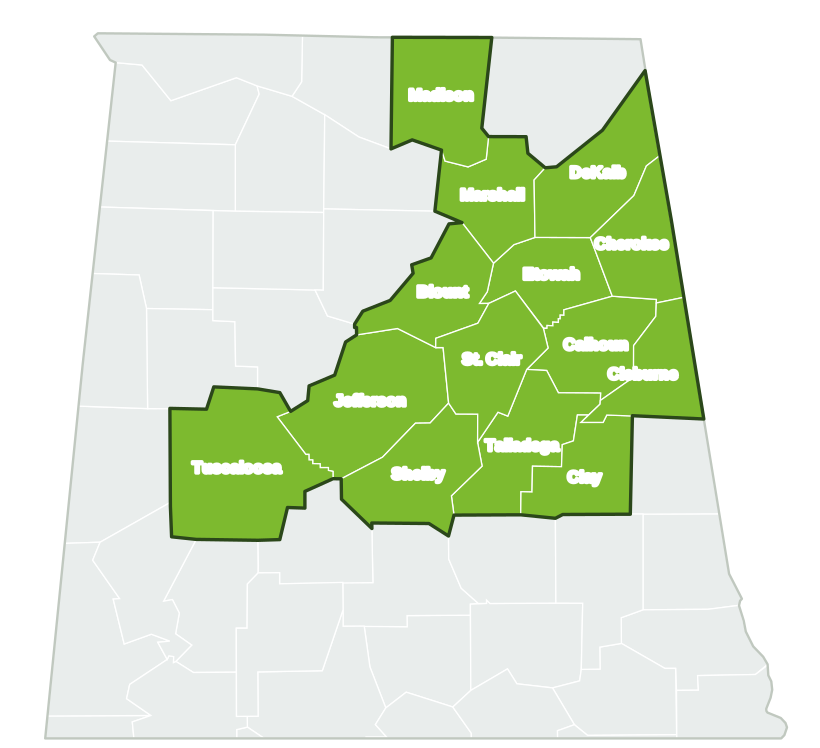
Counties we cover
- Blount County
- Calhoun County
- Cherokee County
- Clay County
- Cleburne County
- DeKalb County
- Etowah County
- Jefferson County
- Madison County
- Marshall County
- Shelby County
- St. Clair County
- Talladega County
- Tuscaloosa County
No travel surcharge anywhere in the shaded area. Send your address with the estimate form and we will confirm coverage.